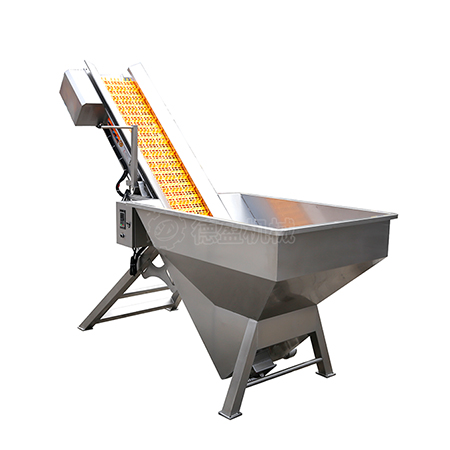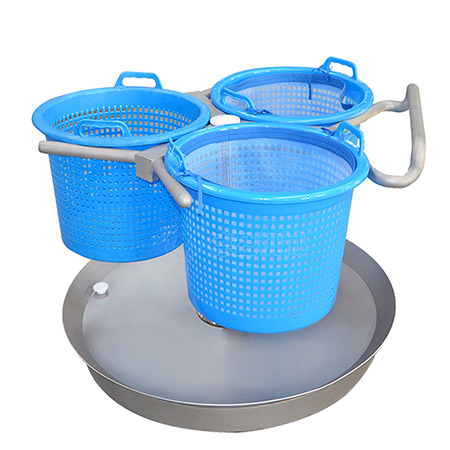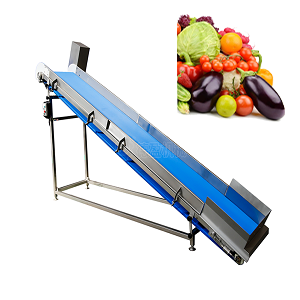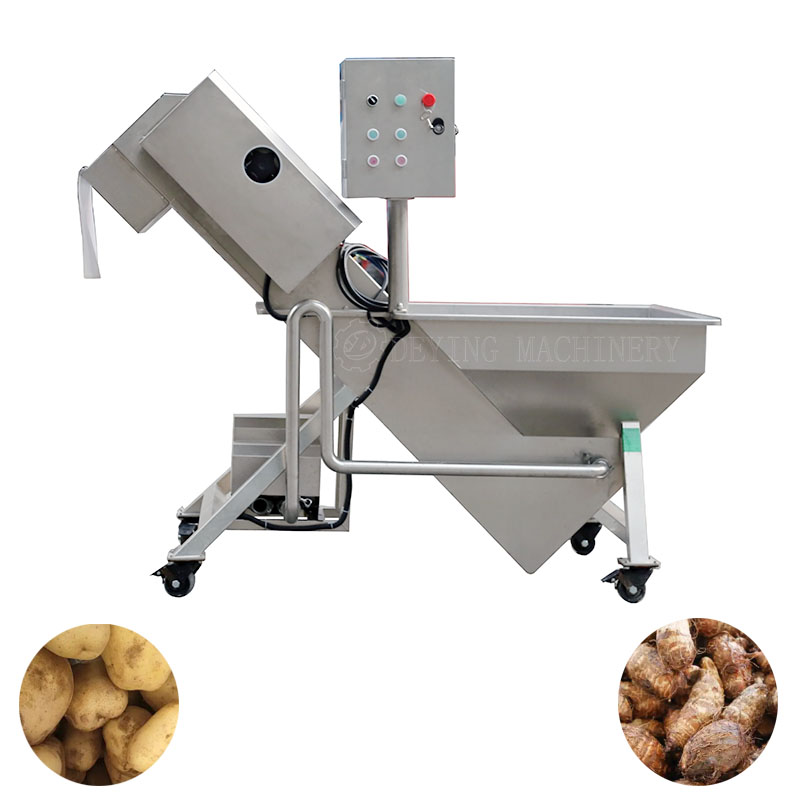
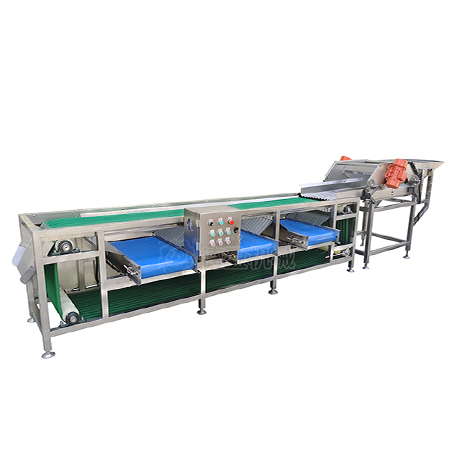






A Fruit Sorting Machine is an automated device designed to sort and separate fruits of different types and qualities based on predetermined standards. It utilizes advanced technology, including cameras and sensors, for visual inspection and analysis of fruits. The machine identifies various fruit characteristics such as size, color, shape, and defects. Upon detection, the system processes this information and classifies the fruits accordingly.
| Technical Parameters | |
| Overall dimensions | 4200×990×1100mm |
| Voltage | 380V |
| Power | 1.73kW |
| Output | 800-1200kg/h |
Usage process:
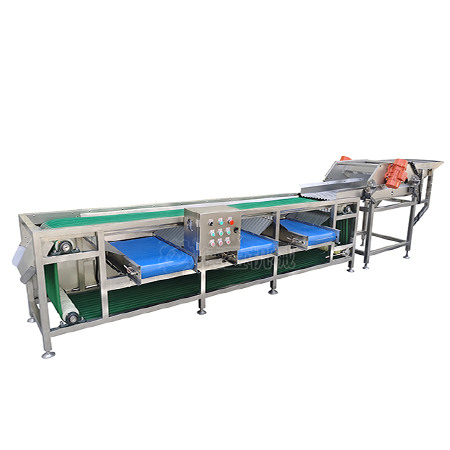
1. No load test: Before formal feeding, the equipment should undergo a no-load test run. Usually, it takes 2 to 3 minutes of air transportation to thoroughly check whether the transmission system and conveyor belt are moving smoothly. At the same time, carefully observe whether there are any abnormal sounds or unstable operation of the equipment. If any abnormalities are found, the machine should be stopped for inspection in a timely manner, and the fault should be eliminated before proceeding to the next step. In addition, it is necessary to check whether each conveyor belt is running normally and whether the belt speed matches.
2. Conveyor sorting: Fruits are evenly fed into the conveyor belt by the elevator and pass through the sorting area in sequence. The sorting is mainly based on the size or weight of the fruit, using rollers or grading screens with different spacing to ensure that the fruit falls into the corresponding collection tank according to its size; Weight grading can also be achieved using weighing sensors. The entire process is continuous, and fruits of different specifications are automatically directed to their respective outlets.
3. Automatic discharge: When the fruit reaches the discharge port corresponding to its own level, the mechanical actuator drops it from the drum conveyor belt or hole conveyor belt. Automatic cyclic conveying and unloading, fruits fall into the collection box or packaging channel below, achieving uninterrupted automatic classification and collection, saving manpower.
Equipment features:
The fully automatic fruit conveying and sorting machine has a compact structure design, with continuous operation of conveying, sorting, and discharging. The no-load test can verify the stability of operation. Sorting is completed through rollers or sensors based on fruit diameter or weight, and automatic discharge is carried out using conveyor belts with automatic cyclic discharge. The whole machine is easy to operate and maintain, capable of continuously and efficiently processing fruits of different specifications, significantly reducing manual intervention and improving sorting efficiency.
Feature:
Material: The main frame of the equipment is made of 304 stainless steel. The conveyor belt, drum conveyor belt, rollers and other components that come into direct contact with the fruit are made of food grade 304 stainless steel or food grade silicone conveyor belt, ensuring corrosion resistance and easy cleaning. The key transmission components are strengthened by heat treatment, and the overall structure is sturdy and durable, meeting the hygiene requirements of food processing.
Advanced sorting and screening technology: combining multi-level roller spacing grading with high-precision weighing sensors, it can accurately classify fruits according to their diameter and weight. Adapt to different varieties, with high sorting accuracy and stable operation.
Diverse specifications: The series of products offer multiple bandwidths (customizable) and sorting levels (customizable), with processing capacities ranging from 800 to 1200 kilograms per hour. The roller spacing or sensor range can be adjusted according to different fruits such as apples, oranges, kiwis, etc., flexibly adapting to various packaging lines and production needs.
Safety certification: The equipment has passed CE certification, ISO9001 certification, patent certification, etc., and is popular in various countries such as Europe, America, Asia, and Southeast Asia.
Core structure composition:
Feeding and conveying system: The fruit is uniformly fed into the main conveyor belt by the elevator. The conveyor belt is made of food grade material and equipped with a speed control device to ensure continuous and uniform distribution of materials, avoiding accumulation or compression damage. At the same time, there is a guiding and sorting mechanism to arrange the fruits in an orderly manner into a single row and enter the sorting area, providing a stable material flow for subsequent precise grading.
Sorting processing system: Combining multi-level roller spacing grading with high-precision weighing sensors, it accurately classifies fruits according to their diameter and weight; The number and parameters of sorting levels can be customized according to needs, suitable for various fruits such as apples and oranges. The sorting process is smooth, efficient, and reliable in accuracy.
Circular conveying and discharging system: After sorting, each level of fruit falls into the corresponding collection box or packaging channel through an independent discharge port. The discharge port is equipped with a buffer device to reduce fruit impact damage. Realize continuous cyclic operation without manual intervention, ensuring the efficient operation of the entire machine for a long time.
Simplify the operational process
Before starting up, conduct a two minute no-load test run to confirm that the equipment is operating normally; Start the feeding elevator, and the fruits are automatically arranged by the conveyor belt and enter the sorting system, completing grading according to weight and fruit diameter; Each level of fruit is unloaded into the collection box through the corresponding discharge port. The whole machine is controlled by a one click start stop control panel, and only needs to monitor the feeding and cleaning of debris for daily use.
Suitable for various processing industries
Vegetable processing industry: used for grading tuber vegetables such as tomatoes, potatoes, onions, etc., screening them by size and weight, removing deformities or damaged individuals, improving the uniformity of the finished product, and facilitating subsequent packaging or deep processing.
Seafood processing: suitable for size sorting of shrimp, shellfish, or small fish, priced according to specifications, and can assist in removing impurities, improving processing efficiency, and reducing damage caused by manual operations.
Quick frozen food industry: used for the specification screening of frozen fruit chunks and vegetable cubes, ensuring uniform product particles, and directly entering the quick freezing production line with automatic discharge to achieve continuous production and reduce the risk of contamination in intermediate links.
Installation and commissioning
1. Preparation before installation: Check the flatness and load-bearing capacity of the site, reserve power supply; Count equipment components, verify random drawings and lists; Prepare commonly used installation tools (such as wrenches, level gauges) and lifting equipment;
2. Equipment installation: Fix the rack according to the foundation diagram, ensuring a horizontal error of ≤ 2mm; install the conveyor belt, sorting roller, weighing sensor, and discharge conveyor belt in sequence, and tighten all connecting bolts; Connect the transmission motor and reducer, adjust the tension of the chain or belt; Check that all rotating components are flexible and not stuck.
3. Debugging and trial operation: Connect the power supply, first jog the motor without load to confirm the correct direction of rotation; Run continuously without load for 2-3 minutes, observe the deviation, abnormal noise, and sensor signals of the conveyor belt; Load a small amount of fruit for trial operation, adjust sorting parameters (such as roller spacing and weighing threshold) to meet the standard; Check the smoothness of the discharge port, confirm it is correct, and then put it into formal production.
Frequently Asked Questions
How to solve the problem of frequent deviation of the conveyor belt of the fruit and vegetable size screening machine?
The conveyor belt often deviates to one side. Firstly, adjust the adjusting bolt at the end of the driven roller and gradually correct the tension; Check whether there are any debris adhering to the surface of the roller and clean it in a timely manner; If the wear is severe, the conveyor belt needs to be replaced.
How to solve the abnormal noise of the transmission components of the fruit sorting conveyor?
Abnormal noise occurs during machine operation. Firstly, check the tension of the chain or belt. If it is too loose, tighten it; if it is too loose or severely worn, replace it; Add lubricating oil to each transmission bearing, check for loose bolts, and tighten them again.
Maintenance method:
Daily maintenance: Check the conveyor belt and rollers for any foreign objects before starting up each day; Observe the deviation, abnormal noise, and smooth discharge of the conveyor belt during operation; After stopping the machine, rinse the fruit parts in contact, wipe the surface of the sensor, check whether the fastening bolts are loose, and record the operating conditions of the day.
Weekly maintenance: Add food grade lubricating oil to each transmission bearing, chain, and gear every week, check the tension of the chain and adjust it; Check if the wiring of each sensor is secure; Clean up the impurities and waste accumulated between the rollers and the weighing table, and calibrate the weighing zero point.
Monthly maintenance: Conduct a comprehensive inspection of all drive belts, rollers, and bearings for wear every month, and replace severely aged or damaged components; Test the insulation resistance of the motor and the oil level of the reducer, and supplement or replace the gear oil; Re tighten the anchor bolts.
Safety Reminder
It is strictly prohibited to plug or unplug power plugs with wet hands; It is strictly prohibited to operate the equipment without grounding.
It is strictly prohibited to insert the body into the machine slot.
Why Choose Deying Machinery?
-Factory-Direct: Integrated manufacturing & trading for efficient, direct communication.
-Custom Solutions: Tailored processing equipment to meet your specific production needs.
-Global Network: Supported by worldwide distributors for seamless after-sales service.
-Learn more about us:https://www.dyfoodmachines.com/about-us/
| Technical Parameters | |
| Overall dimensions | 4200×990×1100mm |
| Voltage | 380V |
| Power | 1.73kW |
| Output | 800-1200kg/h |

Dongguan De Ying food machinery Co., LTD


Copyright © 2026 Dongguan Deying Food Machinery Co., Ltd All rights reserved.


 PDF
PDF